
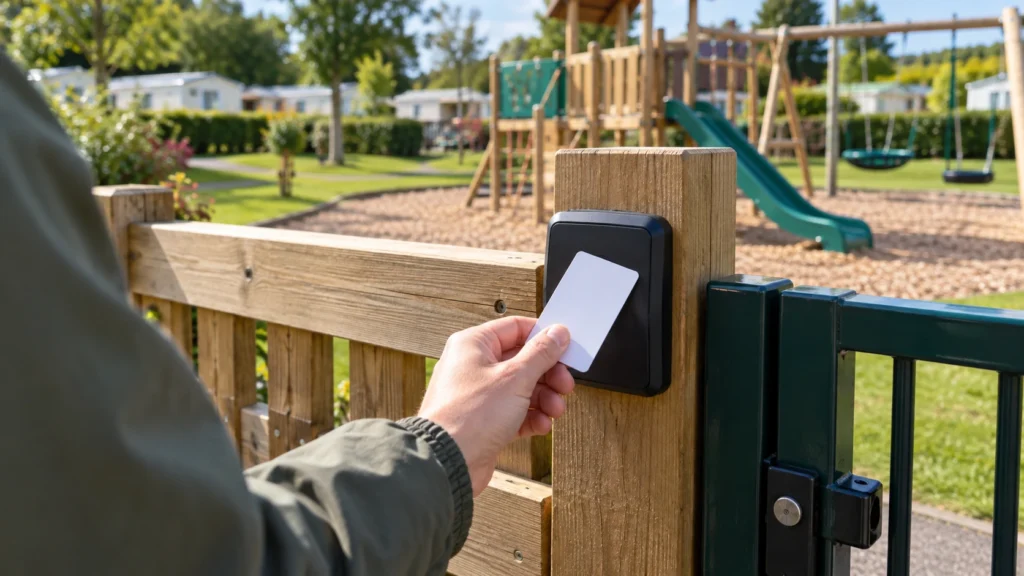
Campsite access cards are easy to overlook until a barrier will not open or a facility door stays locked. Depending on the campsite, a card might identify a guest, control vehicle entry, or allow access to shared facilities. The rules vary, so the most useful habit is to find out exactly what your card does before you need it. These common mistakes can cause avoidable delays, confusion, or extra charges.
Assuming every card works the same way
A card issued at one campsite may work very differently from a card issued at another. Some are for the entrance barrier; others may also be used at sanitary buildings or for services such as electricity. A card may be valid only during your booked stay, and access to certain areas may have separate hours.
At check-in, ask which entrances and facilities the card covers, whether each member of your group needs one, and what to do if it stops working. If you expect to arrive when reception is closed, check the arrival procedure in advance. Having a booking confirmation does not necessarily tell you how to get through a gate after hours.
Leaving the card where it cannot be reached
Packing the access card inside a suitcase seems harmless until you pull up to a barrier with another vehicle waiting behind you. Keep it somewhere the person using the gate can reach without unpacking or leaving the vehicle in an awkward spot. Once you are parked, choose a consistent place for it rather than moving it between coat pockets, bags, and the dashboard.
For example, one adult might take the card to a shared facility while another plans to drive out for groceries. If the card also controls vehicle entry, the driver could be stranded at the gate on returning. Agree on who carries it, or ask reception whether additional cards are available and how they work.
Letting someone else use your card
It can be tempting to lend a card to a visiting friend or pass it through a gate to help another driver. That may conflict with the campsite’s access rules and make it harder for staff to know who is on site. It can also leave your own group without the card when they need it.
Ask how visitors should enter instead. Where a campsite has facilities open to day visitors, access to those areas may be separate from guest access to accommodation or vehicle areas. Do not assume a visitor needs your card simply because you received one at check-in.
Confusing access with payment
An access card is not necessarily an all-inclusive pass. At some campsites, a card may activate a service, record usage, or simply unlock a door. The way electricity, showers, laundry, or other facilities are charged depends on the site. Treating a working card as proof that a service is included can lead to a surprise at checkout.
Before using a service that may carry a charge, check the posted information or ask reception how payment works. If electricity is linked to the card, find out how usage is recorded and whether you need to take any action when connecting or disconnecting. Keep the explanation with your booking details so everyone in your group understands it.
Repeatedly trying a card that does not work
A failed scan does not always mean the card is broken. You may be at the wrong reader, using an entrance outside its access hours, or holding the card incorrectly. Read any instructions at the gate and try once more as directed. If it still fails, use the campsite’s stated contact method rather than repeatedly presenting the card or following another vehicle through.
A gate may also need time to close or reset between vehicles. Wait for its signal before approaching, and never force a barrier or door. If your card fails after reception has closed, the arrival information provided by the campsite is the best place to find the appropriate contact or next step.
Losing track of the card’s condition
Cards are small enough to disappear among receipts, toys, and travel documents. Put yours in a secure, easy-to-find holder, and check for it before leaving a facility or driving away. Avoid bending it or leaving it loose where it could be damaged or accidentally discarded.
If it is lost, tell the campsite promptly. Staff can explain how to restore access and whether there is a replacement fee. Trying to manage without it for the rest of the stay can turn a minor problem into repeated delays, especially if it is needed to re-enter the site. For more detailed information on this topic, read our guide on How to Prepare Your Motorhome for a Comfortable Camping Holiday.
Forgetting the return or checkout procedure
The card may need to be returned, left at a designated point, or used to exit for the final time. Assuming you can hand it back before driving out could be inconvenient if the exit barrier still requires it. Likewise, taking it home by mistake may cause a charge where the campsite requires its return.
Ask about checkout when the card is issued. Note any return location, deadline, or deposit terms, and keep the card accessible until your vehicle has left the site. A brief check before departure saves a trip back to reception and helps settle any service charges correctly.
Campsite access cards work best when their role is clear to everyone sharing them. Confirm the site’s rules, keep the card handy, check charges before using linked services, and know whom to contact if access fails. Those small steps leave less to sort out at a gate and more time to enjoy the stay.